David A. Fanning
music director/conductor
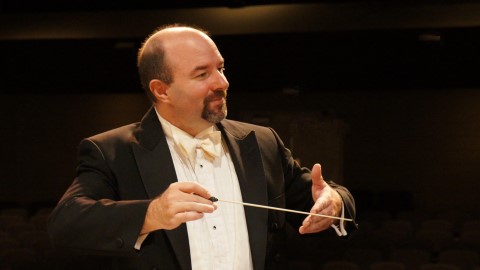
Hailed by The Washington Post as a conductor “with a superlative understanding of the human voice and, especially, orchestra,” Dr. David A. Fanning is an accomplished conductor, pianist, accompanist, composer, and musical director whose career spans orchestral, operatic, theatrical, and chamber music. He has conducted throughout the United States, Europe, and South America and has worked with ensembles and artists across a remarkably broad range of musical genres.
As Music Director of the National String Symphonia, Dr. Fanning combines extensive performance experience with a deep commitment to musical discovery. His programming embraces the established repertoire while reaching beyond the familiar to uncover works that have been overlooked, forgotten, or rarely performed.
A defining aspect of Dr. Fanning’s work is his extensive research into rare repertoire and the music of lesser-known composers. He searches archives, libraries, historical publications, and private collections for works that have largely disappeared from the concert stage. His research frequently leads to composers from historically underrepresented demographic groups whose contributions have received limited recognition in traditional accounts of musical history.
When appropriate, his work goes beyond discovery. Dr. Fanning examines, prepares, and edits historical scores so that these compositions can once again be performed. Through this scholarship, he helps expand the repertoire available to musicians and audiences and brings new perspectives to the continuing story of orchestral music.
Dr. Fanning approaches programming as an opportunity to create connections—between familiar and unfamiliar works, past and present, and composers and audiences. A concert may pair a beloved masterwork with a rarely heard composition or introduce listeners to a composer whose music has been largely absent from the modern stage. His goal is not simply to present something unusual, but to place each work in a compelling musical context.
His conducting is grounded in careful preparation, clear communication, and respect for the musicians he leads. The Washington Post has praised his “sensibility of tempos” and his communication with “instrumentalists and singers alike,” calling these qualities “foundational for success.” A musician who has worked with him describes Maestro Fanning as “an exceptional combination of an excellent musician, an efficient rehearsal director, and a respectful leader who values the musicians he directs,” adding that he “is a rarity among conductors.”
His experience as a pianist and accompanist gives him an intimate understanding of the performer’s perspective, while his work as a composer informs his attention to musical structure, phrasing, and the creative process. His extensive experience in opera and musical theatre has further developed his ability to collaborate with singers, instrumentalists, directors, and other artists.
For Dr. Fanning, conducting is ultimately an act of communication. The goal is to create performances in which musicians can contribute their individual artistry while working toward a shared musical vision—and in which audiences can encounter both the familiar and the unexpected.
Through the National String Symphonia, he continues to build an artistic program that honors the great repertoire while expanding the boundaries of what audiences hear. By championing rediscovered works, supporting new music, and bringing overlooked composers into the concert repertoire, Dr. Fanning seeks to make the musical landscape richer, broader, and more representative of the extraordinary range of voices that have shaped it.